

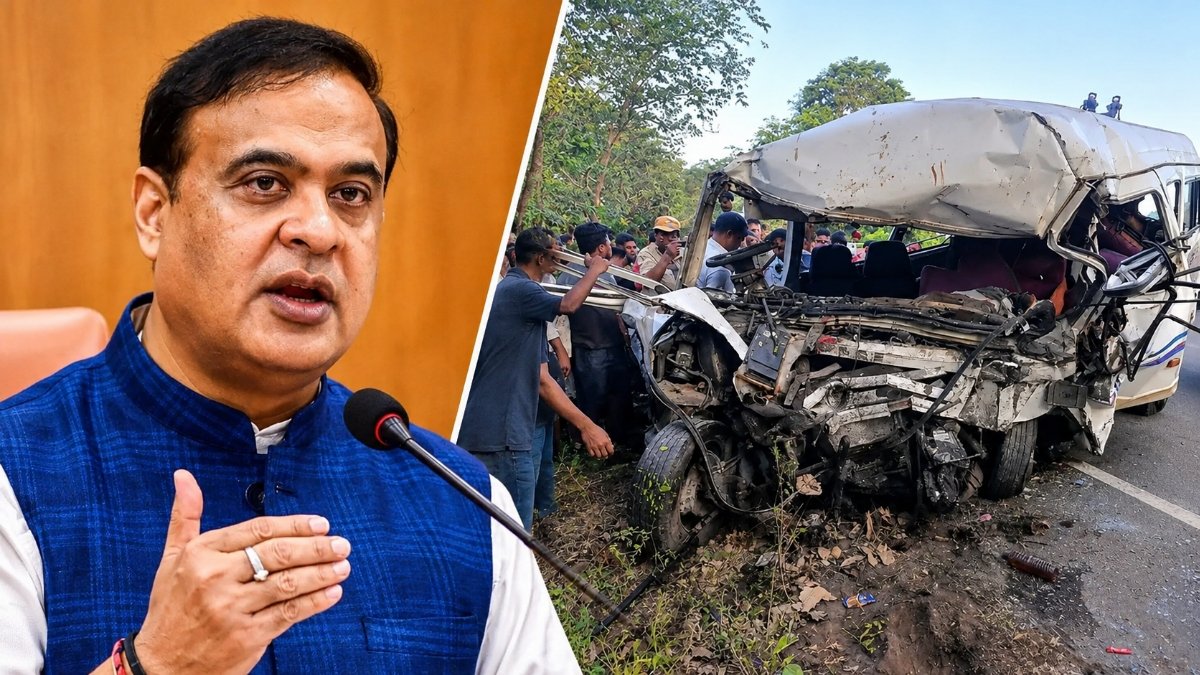
Guwahati, November 16: Assam Chief Minister Himanta Biswa Sarma has announced a 12-point Assam road safety action plan aimed at reducing road accidents, strengthening traffic enforcement and improving emergency medical response across the state.
The announcement comes three days after a devastating collision between a passenger Force Traveller and a container truck near Rangajan in Golaghat district, close to Kaziranga National Park, claimed 26 lives and left around 20 people injured.
The accident, which occurred on November 13 along National Highway 715 near Hathikuli Tea Estate in the Kohora area, has renewed concerns over speeding, commercial vehicle safety, traffic rule violations and the availability of emergency medical facilities along highways.
Following a meeting with senior government officials, the Chief Minister announced a series of measures and made it clear that there would be zero leniency towards those violating traffic rules.
Assam’s 12-Point Road Safety Action Plan
The new Assam road safety action plan focuses on stricter enforcement, safer road infrastructure, responsible driving and improved emergency assistance.
1. Activation of District-Level Road Safety Task Forces
District-level road safety task forces will be activated in accordance with Supreme Court directions to strengthen road monitoring and enforcement.
2. Mandatory Speed-Limiting Devices in Commercial Vehicles
Speed-limiting devices will be made mandatory in all commercial vehicles. Strict action will be taken against those found tampering with these systems.
3. Special Traffic Checks Between 3 PM and 9 PM
Police and enforcement agencies will intensify checks between 3 PM and 9 PM, targeting overspeeding, rash driving and drunk driving.
4. Identification and Improvement of Accident-Prone Locations
Accident-prone stretches will be identified and improved through pedestrian crossings, traffic signals, proper street lighting and repairs to damaged road dividers.
5. Stricter Driving Licence Tests
Driving licence tests will be strengthened to ensure that applicants demonstrate adequate driving skills and awareness of road safety regulations.
6. Investigation of Every Road Accident
Every road accident will be analysed to identify its causes. Corrective measures will subsequently be introduced to prevent similar incidents.
7. Zero-Fatality District Programme
A Zero-Fatality District Programme will be launched with clearly defined targets, timelines and accountability mechanisms.
8. Strict Enforcement of Helmet Rules
Helmet regulations will be enforced without exception, including for women and children travelling as pillion riders on two-wheelers.
9. Suspension of Driving Licences of Repeat Offenders
Driving licences of habitual traffic offenders will be suspended in accordance with applicable legal provisions.
10. Cancellation of Permits for Repeated Commercial Vehicle Violations
Commercial vehicle permits will face cancellation in cases of repeated traffic violations, particularly when a vehicle records 34 or more violations in a year.
11. Improved Emergency Healthcare Along Highways
Hospitals located along highways will be strengthened with adequate doctors, medical personnel, medicines and emergency equipment to improve post-accident treatment.
12. First-Aid Training for Roadside Hotel and Dhaba Workers
Road safety volunteers, including employees of roadside hotels and dhabas, will receive training in first aid and emergency response. Their contributions to road safety will also be recognised annually.
Kaziranga Tragedy Raises Questions Over Commercial Vehicle Safety
The November 13 accident at Rangajan, near Hathikuli Tea Estate in the Kohora area, involved a passenger Force Traveller and a container truck on National Highway 715.
The head-on collision was so severe that the front portion of the passenger vehicle was completely mangled. At least 26 people, including women, children and college students, lost their lives, while around 20 others were injured.
The investigation has brought the safety record of the passenger vehicle under scrutiny. Officials have flagged its alleged history of overspeeding and possible violations of passenger capacity regulations.
According to information emerging from the investigation, the vehicle had previously received multiple traffic challans for overspeeding. An official of the Golaghat District Transport Office reportedly said the vehicle was fined Rs 4,000 in Jorhat on March 3 after allegedly being detected travelling at 102 kmph. It had also received other overspeeding challans in the Kaziranga area.
Investigators are also examining the suspected removal of the vehicle’s mandatory speed-limiting device and the circumstances surrounding the appointment of a driver aged over 60.
Bokakhat Police arrested the vehicle’s owner, Anjir Ali, from Nagaon district on the evening of November 14. He is facing allegations of violations of motor vehicle regulations in connection with the accident.
The police investigation is continuing to establish the circumstances that led to the collision and whether violations of safety regulations contributed to the tragedy.
Why the New Road Safety Measures Matter Beyond Assam
The significance of Assam’s 12-point road safety initiative extends beyond the state. Road safety remains a major public policy challenge across India, particularly on highways where passenger vehicles, commercial transport and long-distance traffic share road space.
The Kaziranga accident has highlighted several interconnected issues, including vehicle fitness, speed control, passenger safety, driver monitoring, traffic enforcement and access to emergency medical services.
The proposed mandatory speed-limiting devices and action against repeated violations seek to address compliance failures involving commercial vehicles. Similarly, the proposed Zero-Fatality District Programme places emphasis on measurable targets and administrative accountability.
The decision to strengthen highway hospitals and train roadside workers in first aid also recognises that preventing accidents is only one part of road safety. Timely medical assistance after a collision can be equally important in saving lives.
However, the effectiveness of these measures will depend on implementation, regular inspections, transparent enforcement and monitoring of results.
Implementation Will Be the Key Test
Assam’s new action plan sets out a broad framework covering accident prevention, traffic enforcement, road infrastructure and emergency response. The challenge now is to translate these announcements into measurable improvements at the district level.
Authorities will need to ensure that speed-limiting devices function properly, repeat offenders are monitored, accident-prone stretches receive timely improvements and highway hospitals have the resources to respond to emergencies.
The Kaziranga tragedy has brought the human cost of road safety failures into sharp focus. The real test of the Assam road safety action plan will be whether it can prevent similar tragedies and make roads safer for commuters, students, tourists and commercial vehicle operators.
Also Read: Kaziranga Accident: CM Visits Site as Death Toll Rises to 26; Rs 9 Lakh Compensation Announced