

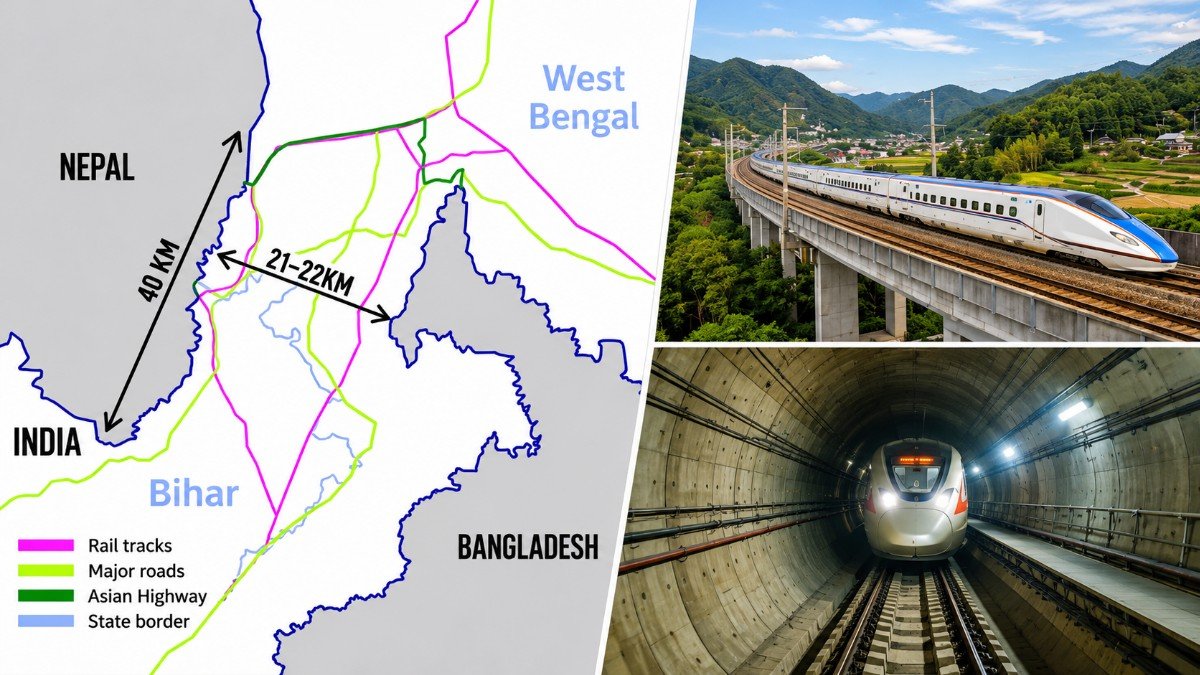
Guwahati, November 4: The proposed Delhi-Guwahati bullet train project may require a special engineering solution to cross the strategically important Siliguri Corridor, popularly known as the Chicken’s Neck. The train may pass through an underground tunnel or an elevated corridor, Chief Minister Himanta Biswa Sarma said on Tuesday.
The proposed high-speed rail connection between New Delhi and Guwahati is expected to reduce travel time between the national capital and Assam’s largest city to around eight hours. However, the route through the narrow Siliguri Corridor presents a major engineering challenge, requiring a separate railway track and specialised construction technology.
Speaking to the media, Sarma said the alignment and technology for the proposed railway network had not yet been finalised. He said he would discuss the technical requirements with Union Railway Minister Ashwini Vaishnaw during his next visit to New Delhi.
“The railway line has been approved. Several steps remain, including surveys and other related work. The first good news is that Guwahati has been included in the bullet train map. The remaining work now needs to be taken forward,” the Chief Minister said.
Why Does Chicken’s Neck Require Special Engineering?
The Siliguri Corridor, commonly known as Chicken’s Neck, is a narrow strip of land in West Bengal that connects the northeastern states with the rest of India. It is strategically important from both geographical and national security perspectives.
According to Sarma, the corridor is approximately 22 km wide at its broader stretch, while it narrows to around 16 km at certain points.
The region already has existing railway lines and national highways. Therefore, constructing an additional dedicated railway track for high-speed trains will require careful planning and a specialised engineering approach.
The Chief Minister said the proposed bullet train could either pass beneath the corridor through an underground tunnel or run above the ground through an elevated railway corridor.
“Whether the bullet train will pass beneath Chicken’s Neck or through an elevated corridor will have to be discussed. I will meet the Railway Minister during my next visit to Delhi and discuss these issues,” he said.
He also pointed out that the existing railway tracks cannot be used for bullet train operations, making a separate railway line necessary.
Sarma said that without a dedicated route, the bullet train would have had to stop at Siliguri instead of continuing towards Guwahati.
Delhi-Guwahati Journey May Take Around Eight Hours
One of the major expected benefits of the proposed Delhi-Guwahati bullet train is a significant reduction in travel time.
According to the Chief Minister, the journey between New Delhi and Guwahati could take approximately eight hours once the proposed high-speed rail service becomes operational.
At present, train journeys between Delhi and Guwahati take considerably longer, depending on the service. The Rajdhani Express takes approximately 27 hours, while the Avadh Assam Express takes around 42 hours.
The proposed eight-hour journey would represent a substantial reduction in travel time and could improve connectivity between Assam and the national capital.
However, the eight-hour travel time is an indicative target and not a confirmed operational schedule. The final journey time will depend on the route alignment, technical specifications and other project details.
Centre Approves Proposed High-Speed Rail Corridor to Guwahati
Union Railway Minister Ashwini Vaishnaw announced on October 31 that Prime Minister Narendra Modi had approved the proposed Northern High-Speed Rail Corridor connecting several major cities, including Guwahati.
The proposed route will connect New Delhi with Agra, Kanpur, Lucknow, Ayodhya, Varanasi, Prayagraj, Patna, Siliguri and Guwahati.
Chief Minister Sarma said the Centre had initially indicated that extending the bullet train network to Guwahati might not be feasible.
However, following his discussions with Prime Minister Narendra Modi and Railway Minister Ashwini Vaishnaw, the proposal to extend the high-speed rail network to Guwahati received support, he said.
The inclusion of Guwahati in the proposed corridor is being seen as an important development for Assam and the entire Northeast.
Surveys and Technical Planning Yet to Be Completed
Despite the proposed inclusion of Guwahati in the high-speed rail network, several important stages remain before the project can move towards construction.
These include detailed surveys, finalisation of the route alignment, selection of appropriate technology, engineering design and construction planning.
The method of crossing Chicken’s Neck remains one of the most important technical issues to be resolved. The Railway Ministry will have to examine the feasibility of an underground tunnel and an elevated corridor before a final decision is taken.
The project could require substantial investment, particularly if specialised infrastructure is needed to cross the narrow corridor.
While the proposed bullet train connection offers the possibility of reducing the Delhi-Guwahati journey to around eight hours, the final route, construction timeline, project cost and technical arrangements are yet to be determined.
For Assam and the Northeast, the proposed high-speed rail connection could mark a major step towards faster connectivity with the rest of the country.