

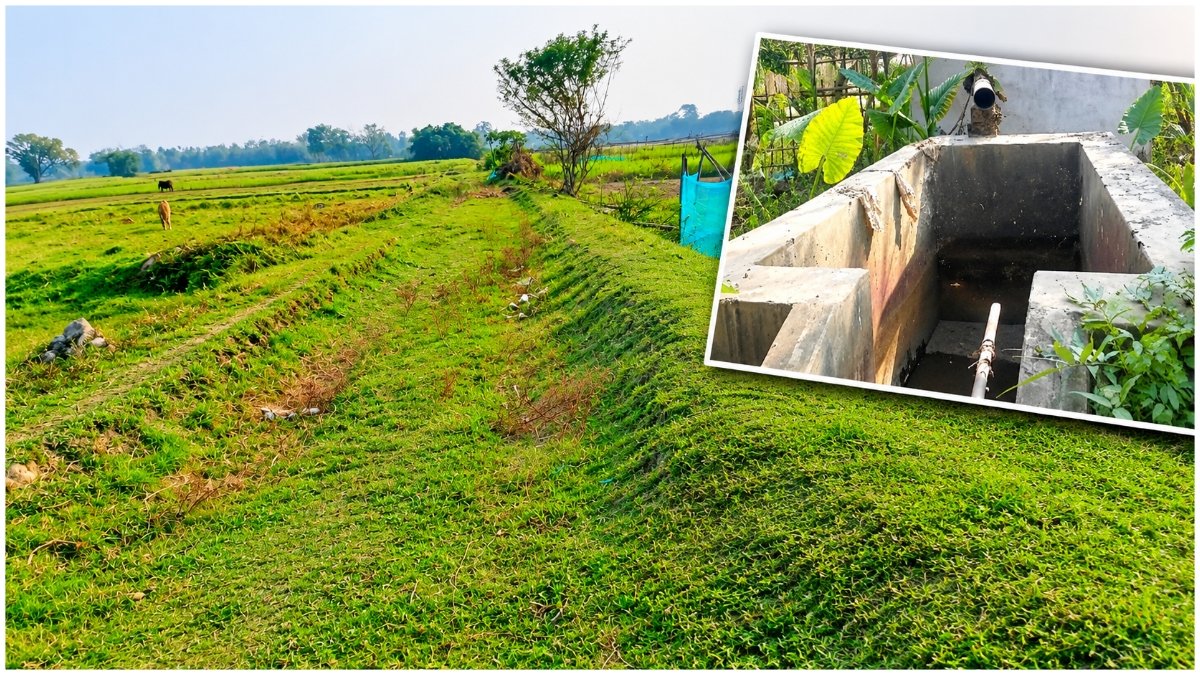
Nagaon: Lack of coordination between the Agriculture and Irrigation departments, government apathy and alleged negligence by departmental officials have continued to hamper the growth of Assam’s agricultural sector. Although irrigation is essential for agricultural development, the Irrigation Department has allegedly failed to maintain proper coordination with the Agriculture Department to identify farmland that requires irrigation facilities. On the other hand, the Agriculture Department is also reportedly not fully aware of the locations where irrigation schemes have been implemented.
However, with both departments recently placed under the charge of the same minister, Pijush Hazarika, efforts to improve coordination between them have become visible to some extent.
But the ground situation remains worrying. In Nagaon district, as in several other parts of Assam, more than half of the irrigation schemes are either partially functional or completely defunct, leaving farmers without adequate water supply.
According to a senior source in the department, although the government has shown interest in constructing new irrigation schemes, it has not demonstrated similar commitment towards repairing and upgrading older projects to restore their functionality. As a result, several old schemes have become defunct, while water supply channels have been blocked. Some canals and drainage channels have also become overgrown with vegetation.
There are also allegations that the preference of senior departmental authorities for constructing new schemes instead of repairing existing ones may be linked to commission-related interests.
Nagaon district has three irrigation divisions: the Nagaon-Batadrava-Raha-Barhampur Division, the Kaliabor-Samuguri Division and the Dhing-Rupahihat Division. Together, they have 172 irrigation schemes.
Of these, only 62 are fully functional. Division-wise, 25 schemes are fully functional under the Nagaon-Batadrava-Raha-Barhampur Division, 26 under the Kaliabor-Samuguri Division and only 11 under the Dhing-Rupahihat Division.
Another 63 schemes are partially functional. Of these, 36 fall under the Nagaon-Batadrava-Raha-Barhampur Division and 27 under the Kaliabor-Samuguri Division.
Meanwhile, 40 schemes are completely defunct. These include 25 under the Nagaon-Batadrava-Raha-Barhampur Division, 11 under the Kaliabor-Samuguri Division and four under the Dhing-Rupahihat Division.
In addition, construction work is currently underway on seven new schemes. Four are being constructed under the Nagaon-Batadrava-Raha-Barhampur Division and three under the Kaliabor-Samuguri Division.
One of the most significant figures emerging from the departmental data is that Nagaon district has the potential to bring a total of 39,126 hectares of farmland under irrigation. Of this, 20,271 hectares fall under the Nagaon-Batadrava-Raha-Barhampur Division, 18,157 hectares under the Kaliabor-Samuguri Division and 698 hectares under the Dhing-Rupahihat Division.
However, against this vast potential, irrigation facilities are currently available to only 6,609 hectares of farmland. This includes 4,036 hectares under the Nagaon-Batadrava-Raha-Barhampur Division, 2,074 hectares under the Kaliabor-Samuguri Division and just 499 hectares under the Dhing-Rupahihat Division.
Meanwhile, allegations of serious irregularities have also surfaced in the upgradation work of the Dakorghat (Baw) Lift Irrigation Scheme under the Nagaon-Batadrava-Raha-Barhampur Division.
In this connection, the Nagaon district committee of the Krishak Mukti Sangram Samiti (KMSS) had submitted a complaint to the Chief Engineer of the Irrigation Department through the Superintending Engineer of the Nagaon Circle.
Jiten Borah, secretary of the Nagaon district committee of KMSS, said, “A plot of land beside the canal at Dakorghat could not be used for Sali paddy cultivation this year. There were discrepancies in the utilisation of the Rs 1 crore 28 lakh 34 thousand allocated during 2023-24 for the repair of the canal and the Dakorghat (Baw) Lift Irrigation Scheme. Moreover, allegations of irregularities have also been raised regarding the Rs 7 lakh 67 thousand 300 allocated for installing new Hume pipes. There are allegations that old pipes were used instead of new ones.”
The farmers’ leader further said, “A solar pump installed in the Dakorghat fields has not been repaired even after two years. We cultivated cucumber in this field this year, but the crop dried up due to a shortage of water. Fifteen unemployed youths associated with agricultural activities had to migrate to other states in search of work.”
The allegations of neglect are not limited to the Irrigation Department. The Agriculture Department has also come under criticism for allegedly failing to give adequate attention to farmers.
In the undivided Nagaon district, there are 3,82,546 farmer families. Of these, 77,113 are landless farmer families, while 1,75,852 families own only small amounts of agricultural land.
A large number of these families have reportedly not received the benefits of government agricultural schemes. Many are not even adequately informed about the schemes available to them.
Allegations have also been raised that weak awareness campaigns among farmers and poor departmental monitoring have created opportunities for the misuse and misappropriation of funds allocated under government schemes.
Despite nearly 200 Gram Sevaks being deployed in Nagaon district, many farmers in rural areas have complained that they receive little or no assistance from them.
Questions have also been raised about the role of Gram Sevaks in reaching out to farmers, informing them about government schemes, providing agricultural advice and ensuring that benefits reach the actual beneficiaries.
Prime Minister Narendra Modi has repeatedly stated that the BJP government gives the highest priority to farmers’ development. However, the complaints of farmers in Nagaon, the poor condition of irrigation schemes and the alleged inactivity of the Agriculture Department present a worrying picture that contrasts with the government’s claims of prioritising farmers’ welfare.
Agricultural development cannot be achieved merely by announcing new schemes. Reviving old irrigation projects, improving coordination between departments and ensuring the proper utilisation of public funds are equally important.
Otherwise, the district’s vast irrigation potential will remain confined to official records, while the hardships faced by farmers will continue.

Chandan Jyoti Borah
Chandan Jyoti Borah is a senior journalist from Nagaon, Assam, with over 21 years of experience in journalism. He has worked with several leading Assamese newspapers, including Saptahik Janaprahari, Ajir Dainik Batori and Dainik Asom. He has also contributed to Saregama and Saptahik Asom.
He received the Kunja Bala Devi Memorial Award in 2018 and the Chief Minister's Media Fellowship from the Government of Assam. He has also served as Secretary of Nagaon Press Club, All Assam Journalists' Union (AJU), Nagaon District Committee, and Nagaon Print Media Association.