

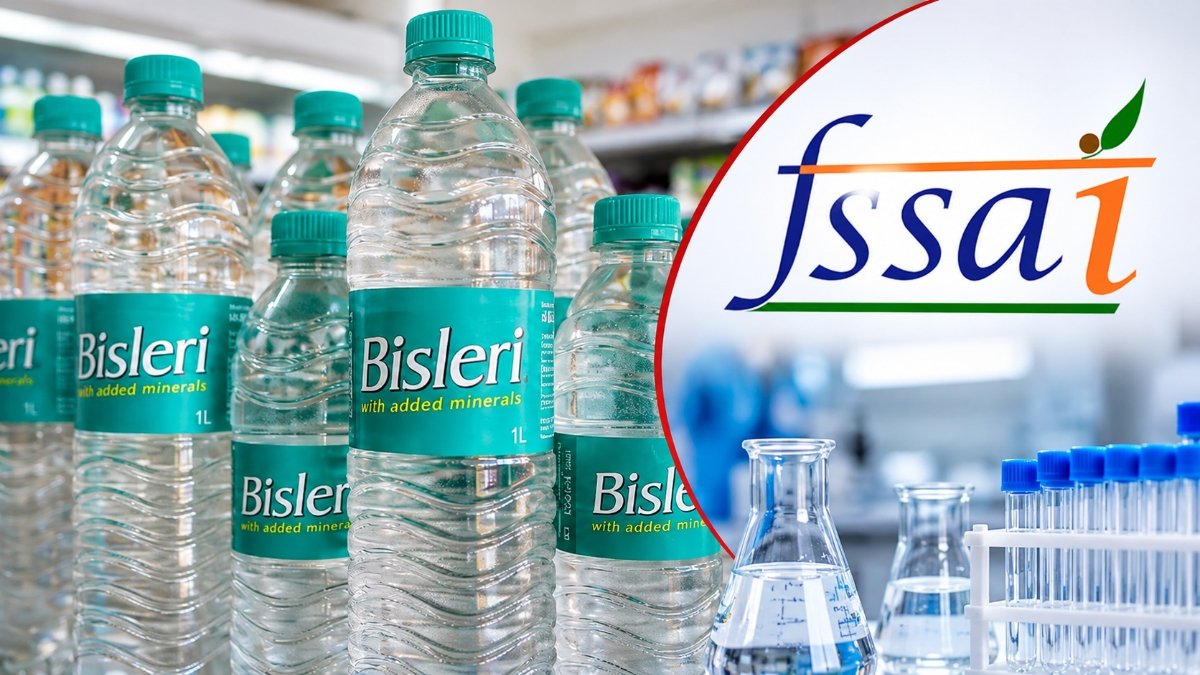
New Delhi, November 23: The Food Safety and Standards Authority of India (FSSAI) has approved prosecution proceedings against Bisleri International Private Limited after a sample of its packaged drinking water was declared unsafe during laboratory testing. The regulatory action has prompted the company to issue a clarification, stating that the matter relates to a specific batch manufactured at its Goa facility in September 2025.
According to FSSAI, a regulatory sample of packaged drinking water was collected from Bisleri International for laboratory analysis. The sample reportedly failed to meet the prescribed bromate limit during the initial examination.
Following an appeal by the company, the sample was sent to a referral food laboratory for further testing. The subsequent examination also reported the presence of Polycyclic Aromatic Hydrocarbons (PAHs).
Based on the findings, the sample was declared unsafe under the Food Safety and Standards Act, 2006. FSSAI subsequently approved prosecution proceedings against Bisleri International Private Limited.
What Did the Laboratory Tests Reveal?
The case concerns a sample categorised as packaged drinking water, other than mineral water.
According to the company’s clarification, FSSAI collected six samples from its Goa manufacturing facility on September 30, 2025. Initial testing found that five samples met the prescribed standards.
However, the sixth sample recorded a bromate level of 12 micrograms per litre, against the permissible limit of 10 micrograms per litre.
The company challenged the initial findings and appealed for further examination.
Bisleri Questions the Test Results
In its statement, Bisleri said the matter was around 14 months old and related to a particular batch manufactured at its Goa facility in September 2025.
The company said that following its appeal on November 22, 2025, FSSAI sent the sample to a referral laboratory for retesting.
According to Bisleri, the referral laboratory found the bromate level within the prescribed limit but also reported the presence of Polycyclic Aromatic Hydrocarbons (PAHs).
Citing differences between the test results, the company said it subsequently arranged an independent examination of the same sample at an FSSAI-recognised laboratory. Bisleri claimed that this test also found the bromate level within the permissible limit.
Company Says It Submitted Independent Test Results to FSSAI
Bisleri stated that it submitted the independent laboratory findings to FSSAI’s Western Regional Office through a formal letter on February 2, 2026.
The company claimed that it received no further communication from the regulator after submitting the results. It therefore believed that the matter had been closed.
Bisleri also stated that, as of the date of its statement, it had not received any formal notice through email or in hard copy. It further claimed that no such notice was available on the FSSAI website.
These are the company’s claims and have not been independently established through the material provided.
Bisleri Says Water Safety Remains Its Top Priority
Defending its quality-control procedures, Bisleri said it follows a 10-stage manufacturing process involving more than 90 quality checks.
The company maintained that consumer safety remains its highest priority and said it would continue cooperating with FSSAI to resolve the matter through the appropriate regulatory process.
The development concerns a specific water sample linked to a particular batch manufactured at the company’s Goa facility. It does not, by itself, establish that all Bisleri products are unsafe.
The differing laboratory findings and the regulatory action have brought the quality-testing process under scrutiny. The next stage of the proceedings will be important in determining the outcome of the case.
Also Read: Amul Milk Price Hike: Milk Prices to Rise by Up to Rs 4 Per Litre from November 12