

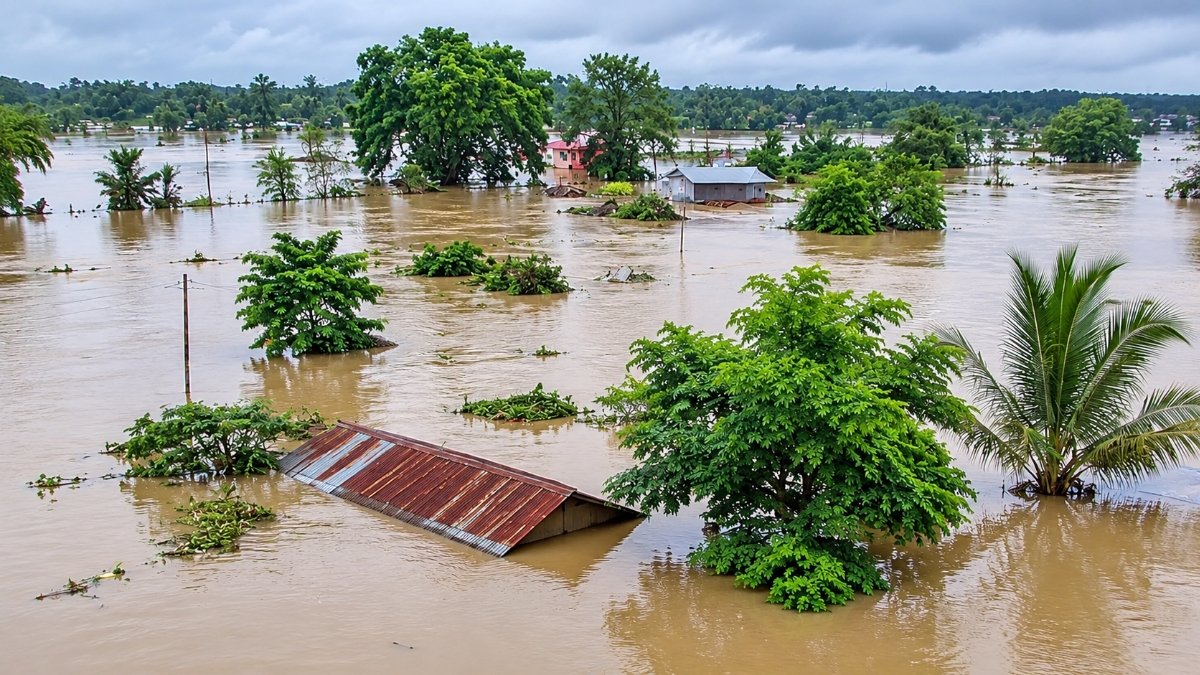
Guwahati, November 12: In a major shift towards preventive disaster management, the BJP-led government in Assam has planned to introduce the Assam Flood Plain Zoning Bill, 2026, which is expected to help regulate construction and land use along the state’s major river channels and thereby curb annual flood devastation.
Assam Chief Minister Himanta Biswa Sarma recently announced this, adding that the proposed bill is likely to be tabled in the forthcoming session of the Assam Legislative Assembly. The Chief Minister also chaired a high-level review meeting on the issue to assess the progress of drafting the legislation.
The urgency for a statutory land-use framework intensified following the devastating floods in July 2026 across Upper Assam, specifically in Sivasagar, Charaideo, Jorhat and Golaghat, which claimed 104 lives and caused widespread displacement and crop losses.
Aligning with the technical guidelines circulated by the Union Ministry of Jal Shakti, the proposed Assam Flood Plain Zoning Bill adopts floodplain zoning as a non-structural mitigation measure.
The Chief Minister said that while the state must curb unregulated encroachment in high-risk flood zones, the legal framework must include clear safeguards to protect the rights and livelihoods of indigenous Scheduled Tribe (ST) and Scheduled Caste (SC) riverbank communities.
It may be mentioned that Assam’s flood-control strategy has relied heavily on structural interventions such as embankments. However, severe embankment breaches and extreme upstream rainfall events have exposed the limitations of relying solely on physical barriers.
“The proposed bill aims to categorise land according to its degree of flood vulnerability. It will also help stop unplanned urbanisation and infrastructure development directly in the path of surging waters,” he said.
The legislation will introduce several structural and administrative mechanisms across the Brahmaputra and Barak river basins. While low-lying areas will be categorised as prohibited zones, where permanent construction will be strictly barred to allow the natural flow of rivers, there will also be restricted zones where development will be permitted only under strict flood-resilient conditions.
The zoning regulations will apply across both rural and urban jurisdictions throughout Assam. Dedicated flood zoning authorities will be established at multiple administrative levels to map floodplains, notify boundaries, regulate land-use permissions and oversee enforcement.

Anup Sharma is a senior journalist with over two decades of experience covering India's Northeast. Based in Guwahati, Assam, he has worked with leading media organisations including The Times of India, The Telegraph and The Pioneer. He is currently contributing to Agence France-Presse (AFP). His extensive experience in regional journalism brings valuable editorial insight and a deep understanding of the Northeast to EasternLens.