
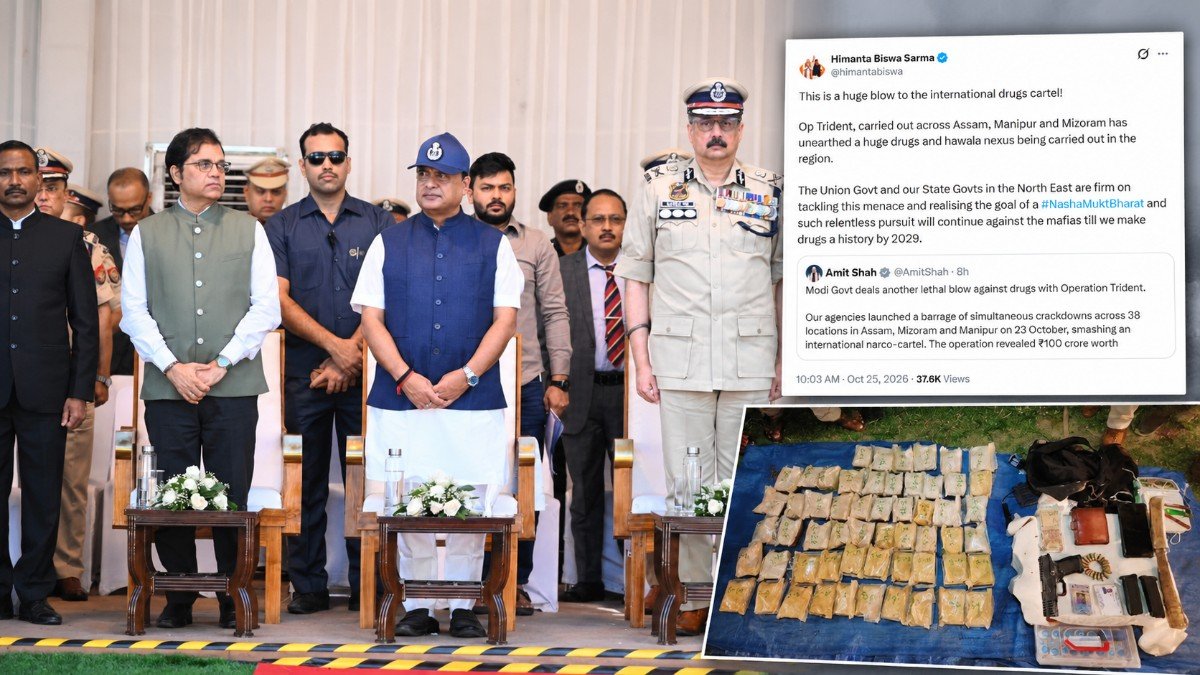
Guwahati, October 25: Himanta Biswa Sarma has backed Operation Trident, the multi-state crackdown targeting a suspected drug trafficking and hawala network across Assam, Manipur and Mizoram. The Assam Chief Minister said the campaign against drug trafficking would continue until the menace is eradicated by 2029.
“This is a huge blow to the international drugs cartel!” Sarma said in a post on X on October 25.
He said Operation Trident, conducted across Assam, Manipur and Mizoram, had uncovered a major drugs and hawala network operating in the region. The Chief Minister also reiterated the commitment of the Union government and northeastern state governments to achieving the goal of a Nasha Mukt Bharat (Drug-Free India).
“Such relentless pursuit will continue against the mafias till we make drugs a history by 2029,” Sarma wrote.
His remarks came after Union Home Minister Amit Shah announced the outcome of coordinated enforcement operations conducted at 38 locations across the three northeastern states on October 23.
Operation Trident Targets Drug Trafficking and Financial Links
Operation Trident was launched by the Narcotics Control Bureau (NCB) in coordination with other central agencies and state police forces. The operation targeted an alleged international narcotics trafficking network and its suspected financial infrastructure.
According to Shah’s announcement, the operation resulted in 18 arrests and uncovered hawala transactions worth approximately ₹100 crore. Authorities also froze 1,424 bank accounts and attached properties valued at ₹17.82 crore.
In addition, enforcement agencies seized 500 detonators and ₹12 lakh in cash.
The operation reflects an approach that goes beyond intercepting narcotics consignments, focusing also on suspected money flows, financial intermediaries and assets allegedly linked to the drug trade.
Alleged Cross-Border Network Under Investigation
According to the Home Minister, the suspected trafficking network operated across the borders of India, Myanmar and Bangladesh through what he described as the “Death Triangle Corridor”.
The investigation has highlighted the importance of tracing both the movement of narcotics and the financial channels allegedly used to settle transactions linked to the trade.
The Enforcement Directorate (ED), the NCB and state police have worked in coordination as part of the wider enforcement effort. The authorities are examining suspected links between cross-border trafficking, hawala transactions and financial assets.
The full extent of the network and the roles of the individuals arrested will depend on the findings of the ongoing investigation. Allegations against those arrested remain subject to the legal process.
Why the Financial Trail Matters
The freezing of 1,424 bank accounts and the attachment of properties worth ₹17.82 crore are among the significant financial measures reported in connection with Operation Trident.
Hawala is an informal money-transfer system that operates through intermediaries outside conventional banking channels. Investigating suspected hawala transactions can help enforcement agencies trace the movement of funds, identify possible facilitators and examine whether criminal proceeds have been channelled into assets or businesses.
The reported ₹100-crore hawala trail has therefore emerged as a major aspect of the crackdown. However, the public announcement does not establish that every frozen account or attached asset was directly involved in narcotics trafficking. Those links must be assessed through the evidence gathered by investigators.
Northeast Governments Reaffirm Anti-Drug Commitment
Sarma’s statement underlined the importance of coordination between the Union government and state administrations in tackling drug trafficking across the Northeast.
The region’s proximity to international borders makes cooperation among enforcement agencies particularly important when investigations involve suspected cross-border supply routes and financial transactions spanning multiple jurisdictions.
The Chief Minister’s reference to Nasha Mukt Bharat also places the operation within the broader national campaign against drug abuse and trafficking. Alongside enforcement, efforts to prevent substance abuse, increase public awareness and support rehabilitation remain important components of addressing the wider drug problem.
Government Sets December 31, 2029, Target
Shah said the operation was part of the government’s resolve to eradicate every drug network by December 31, 2029. He congratulated the anti-narcotics teams comprising central agencies and the police forces of Assam, Mizoram and Manipur.
Sarma echoed that commitment in his post, saying the campaign against drug mafias would continue until drugs were made “history” by 2029.
The results announced so far include 18 arrests, the freezing of 1,424 bank accounts and the attachment of properties worth ₹17.82 crore. Further details about the suspected network and the evidence gathered are expected to emerge as the investigation progresses.