
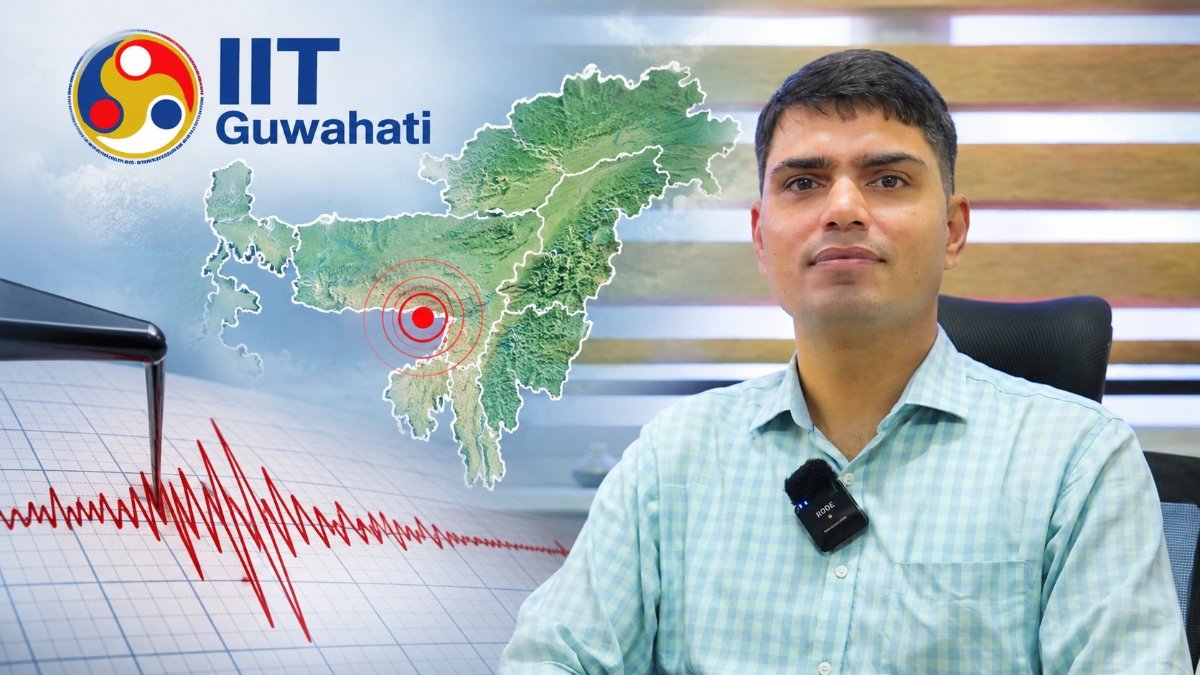
Researchers analysed nearly 6,000 earthquakes recorded over 1,200 years and developed a method to account for uncertainties in seismic hazard assessment across Northeast India.
Guwahati, November 25: Imphal in Manipur faces the highest estimated ground-shaking intensity among eight northeastern cities, according to a study conducted by experts at IIT Guwahati.
The study follows the development of a method by IIT Guwahati researchers to assess the severity of ground shaking during earthquakes in Northeast India.
The team compiled information on earthquakes that occurred over the past 1,200 years to produce a catalogue containing records of nearly 6,000 earthquakes.
They also generated 200 synthetic earthquake catalogues, representing alternative mathematical versions of the historical records. These synthetic catalogues were created by varying earthquake locations and magnitudes within specified uncertainty ranges. A statistical sampling method called Latin Hypercube Sampling was used for this process.
“We used a mathematical technique called Kernel Density Estimation that considers the local differences in earthquake occurrence. We also considered the orientation of the geological faults because earthquake activity is more likely to occur along a fault than in other areas,” explained Prof. Abhishek Kumar, one of the researchers.
He explained that Northeast India lies between two tectonic boundaries and contains the Shillong Plateau and many geological faults, all of which make the region prone to earthquakes.
“The 1897 Shillong earthquake and the 1950 Assam earthquake were devastating to the region. Engineers designing buildings, bridges and other structures must ensure that they can withstand ground shaking during earthquakes. Assessing the extent of ground shaking that could occur during earthquakes is called ‘seismic hazard assessment’,” he said.
It may be mentioned here that seismic hazard assessment methods use information about previous earthquakes and geological faults to estimate how strongly the ground could shake during a future earthquake. However, there are two problems with this approach.
“The first problem is that earthquake activity is not uniform in this region, with some parts experiencing more intense seismic activity than others. The second problem is that historical data is not always accurate because of the absence of modern measurement devices in the past,” he said.
To bridge this gap, Prof. Abhishek Kumar from the Department of Civil Engineering, along with his research graduate, Dr. Niranjan Borah, developed a method that takes these uncertainties into account when estimating seismic hazards.
The findings of this research have been published in the prestigious Journal of Seismology.
“The study area was divided into a geographical grid, and the kernel density method was used to estimate the rate of earthquake occurrence in each cell. The researchers then combined these estimates with mathematical models to calculate potential ground shaking at different locations. They also examined eight cities: Guwahati, Agartala, Imphal, Shillong, Aizawl, Kohima, Gangtok and Itanagar,” he said, adding that the most intense earthquake activity is seen in the Indo-Burma Ranges, followed by western Arunachal Pradesh, central Assam, the Shillong Plateau and southern Sikkim.
The researchers used a measurement called Peak Ground Acceleration (PGA) to estimate the severity of ground shaking during earthquakes. Imphal had the highest estimated level of ground shaking among the eight cities studied.
The IIT Guwahati method estimates how strongly the ground could shake during future earthquakes. This information, along with site-specific assessments such as soil structure, could help engineers and construction specialists design earthquake-resistant structures.
As the next step, the research team plans to incorporate depth-related uncertainties and an earthquake recurrence model into the proposed framework. These enhancements are expected to provide a more comprehensive representation of seismicity, improve the robustness of probabilistic seismic hazard estimates, and further strengthen the applicability of the proposed methodology for seismic hazard assessment in Northeast India.
Also Read: IIT Guwahati, Tata Electronics Join Hands to Boost Semiconductor Education and Research in Northeast

Anup Sharma
Anup Sharma is a senior journalist with over two decades of experience covering India's Northeast. Based in Guwahati, Assam, he has worked with leading media organisations including The Times of India, The Telegraph and The Pioneer. He is currently contributing to Agence France-Presse (AFP). His extensive experience in regional journalism brings valuable editorial insight and a deep understanding of the Northeast to EasternLens.