
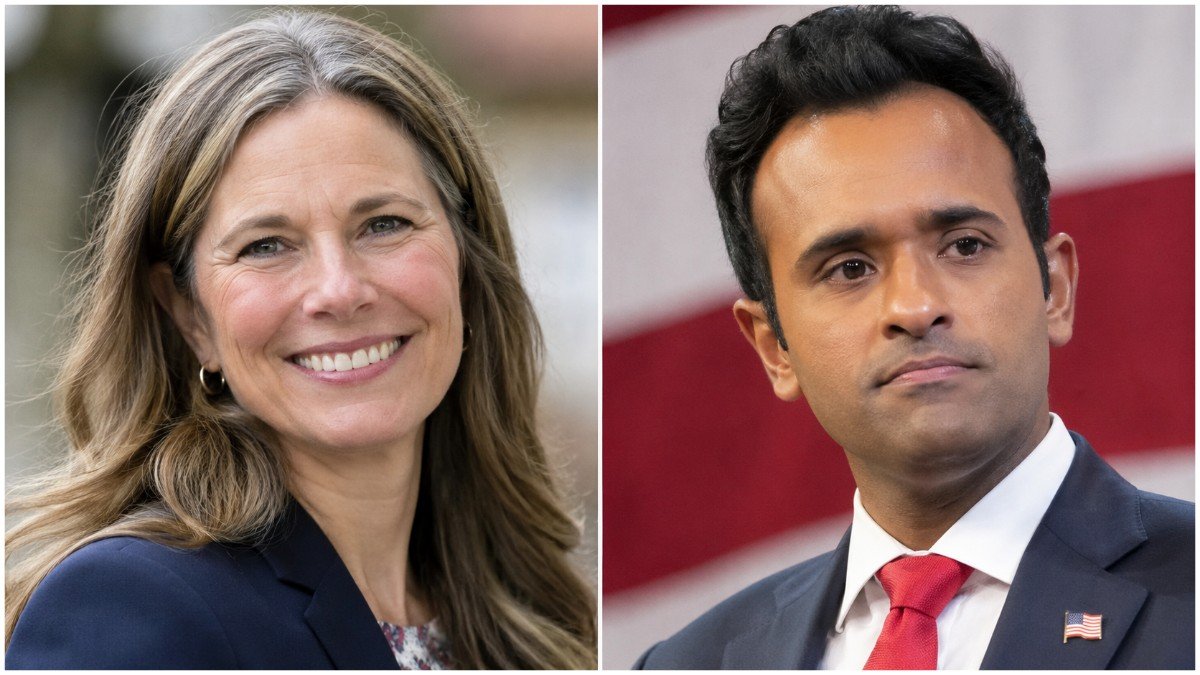
COLUMBUS, November 4: In a significant setback for Republicans and a major breakthrough for Democrats, Dr Amy Acton has defeated Trump-backed Republican Vivek Ramaswamy in the Ohio governor’s race, according to election projections. Her victory marks the return of a Democrat to the state’s top office after 20 years and makes her the first woman elected governor of Ohio.
Acton, 60, a physician and former director of the Ohio Department of Health, defeated Ramaswamy, a billionaire biotech entrepreneur and former 2024 Republican presidential candidate, in the closely watched November 3 election.
The result is particularly significant for Democrats in Ohio, a state that has increasingly leaned towards Republicans during the Donald Trump era. The victory also marks a major political challenge for Republicans, who had rallied behind Ramaswamy with strong support from Trump and other prominent party figures.
Affordability and healthcare at the centre of Acton’s campaign
Acton built her campaign around the everyday concerns of working- and middle-class families, particularly the rising cost of living, affordability and access to healthcare.
She also spoke openly about her difficult childhood in Ohio. Acton said she experienced homelessness as a child and spent part of one winter living in a tent. Her personal experiences became an important part of her campaign narrative, helping her connect with voters facing economic and social challenges.
Her campaign sought to portray her as a candidate who understood the struggles of ordinary families, in contrast to Ramaswamy’s immense wealth and business background.
Acton also capitalised on growing public concerns over the cost of living, fuel prices and the economic impact of the Trump administration’s tariff policies.
Ramaswamy faced despite more than $100 million in spending
The Ohio governor’s contest was one of the most expensive and closely watched political battles in the country.
Ramaswamy and Republican-aligned groups spent more than $100 million on efforts opposing Acton. Billionaire Elon Musk also contributed at least $5 million to a political action committee aligned with Ramaswamy.
President Donald Trump and Vice President JD Vance, who is from Ohio, repeatedly visited the state during the final weeks of the campaign to rally support for Ramaswamy. Their involvement highlighted the national importance of the contest.
Despite the financial backing, high-profile endorsements and extensive campaign efforts, Ramaswamy failed to secure victory.
Acton’s campaign successfully turned the issue of Ramaswamy’s wealth into a political argument, contrasting his financial position with the economic pressures faced by ordinary Ohio residents.
Controversial attack ad involving Acton’s estranged mother
The campaign took a particularly bitter turn during its final month after an attack advertisement featuring Acton’s estranged mother, Donna Arthur, became a major political controversy.
In the advertisement, Arthur described her daughter as a liar and urged voters not to support her.
However, the advertisement drew widespread criticism after details emerged about the family’s history. Acton had been estranged from her mother for nearly five decades. Her mother had lost custody of her children after her husband, Acton’s stepfather, was indicted on charges of raping Acton when she was a child.
The stepfather pleaded not guilty but left the state before he could stand trial.
The advertisement prompted criticism from politicians across party lines, women’s organisations and hundreds of former students of Ramaswamy’s Catholic high school in Cincinnati.
Five former Ohio governors were among those who condemned the campaign tactic, describing it as an unacceptable form of personal political attack.
Ramaswamy defended the advertisement, arguing that it raised questions about Acton’s statements regarding her past. Trump and Vance also defended its use.
The advertisement was eventually taken off the air about a week before Election Day. Ramaswamy had announced a $4 million advertising campaign, of which approximately one-quarter had been spent before the advertisement was withdrawn.
Acton’s COVID-19 leadership made her a familiar face in Ohio
Acton was already a recognisable figure in Ohio politics because of her role during the COVID-19 pandemic.
She served as director of the Ohio Department of Health under Republican Governor Mike DeWine and worked closely with him during the early months of the public health crisis.
Acton appeared alongside DeWine and then-Lieutenant Governor Jon Husted in regular statewide briefings, explaining the public health situation and the administration’s response to the pandemic.
However, her role in implementing restrictions on schools and businesses during the pandemic later became a major point of criticism among Republicans.
Ramaswamy and his allies accused her of being too aggressive in supporting shutdown measures and argued that the restrictions had harmed Ohio’s education system and economy.
DeWine defended Acton’s role during the pandemic, saying that he was ultimately responsible for the administration’s decisions. However, despite defending his former health director, DeWine endorsed Ramaswamy in the governor’s race.
Republican divisions emerged during the primary campaign
Ramaswamy’s path to the Republican nomination was not entirely smooth.
His candidacy faced opposition from Casey Putsch, popularly known as ‘The Car Guy’, a vehicle designer and YouTube personality who attracted support among sections of the party’s working-class base.
Putsch also made indirect ethnic and religious attacks targeting Ramaswamy’s Indian heritage and Hindu faith.
Despite spending only around $130,000 on his primary campaign, Putsch secured nearly 18 per cent of the Republican primary vote. As the general election approached, he announced that he intended to vote for Acton.
Ramaswamy’s nomination had also reshaped the political calculations of several established Republican leaders in Ohio.
DeWine’s decision to appoint his lieutenant governor, Jon Husted, to the US Senate had opened the way for Ramaswamy to emerge as the leading Republican candidate for governor. The decision left several experienced Republican politicians, including the state attorney general and treasurer, adjusting their political plans.
A historic political breakthrough for Ohio Democrats
Acton’s victory ends two decades without a Democratic governor in Ohio. The state has increasingly become a Republican stronghold in recent national elections, making the result particularly important for Democrats.
She will succeed outgoing Republican Governor Mike DeWine, who is barred from seeking another consecutive term because of term limits.
Despite her high public profile during the pandemic, Acton has never held elected office. Her transition from a public health administrator to the state’s highest elected position marks a significant political rise.
Her administration will face major challenges, including the rising cost of living, healthcare access, education and the economic concerns of Ohio families.
The election also demonstrates that Trump’s endorsement and the financial strength of a candidate do not necessarily guarantee electoral success, even in a state where Republicans have enjoyed considerable political support.
For Ohio Democrats, Acton’s victory represents an opportunity to rebuild their political influence. For Republicans, Ramaswamy’s defeat raises questions about the effectiveness of their campaign strategy and the limits of national political endorsements in state-level elections.