

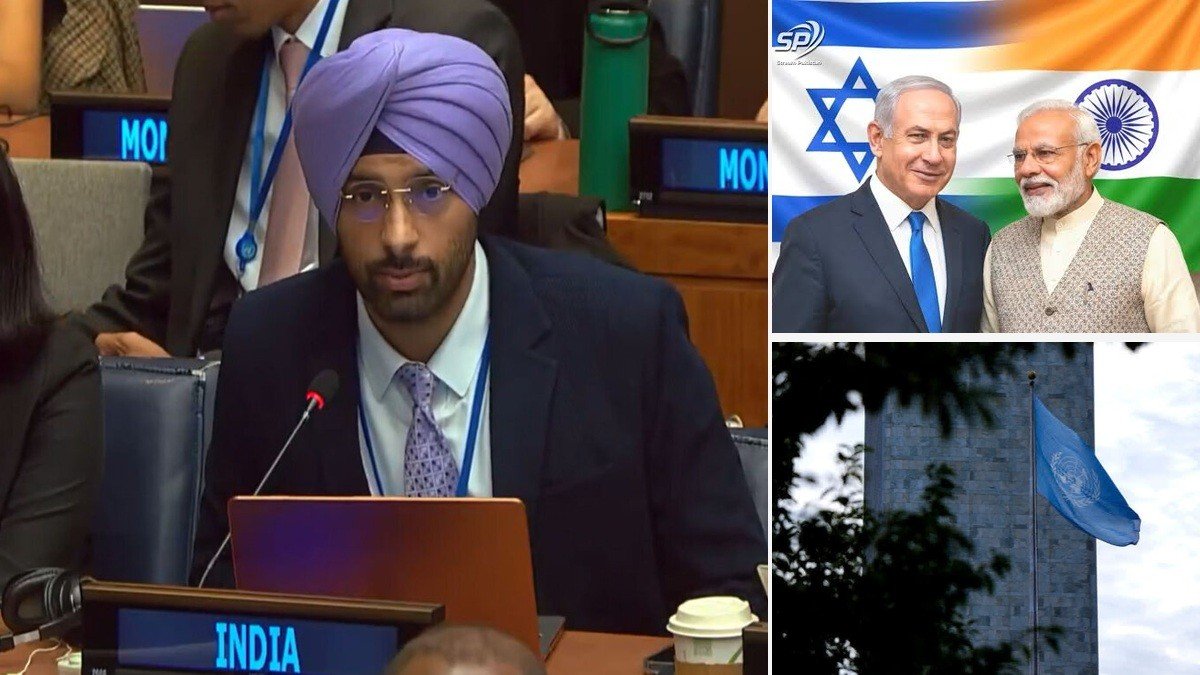
International Desk, November 4: India and Israel were the only two countries to vote against a Pakistan- and Belarus-backed proposal on conventional arms control at the United Nations, even as 180 countries supported the draft resolution at the UN General Assembly’s First Committee.
The vote took place on November 2 during the 81st session of the UN General Assembly. The draft resolution, titled “General and Complete Disarmament: Conventional Arms Control at the Regional and Subregional Levels”, received 180 votes in favour, two against and no abstentions in the 193-member organisation.
India and Israel were the only countries opposing the proposal, which seeks to promote conventional arms control primarily through regional and subregional arrangements.
India argued that national security concerns cannot be restricted to geographical boundaries and that conventional arms control should be treated as a global issue rather than addressed mainly through regional frameworks.
Why Did India Oppose Pakistan’s UN Arms Control Proposal?
Explaining India’s position before the First Committee, Anmol Sher Bedi, First Secretary at India’s Permanent Mission to the United Nations, said New Delhi was not convinced that conventional arms control should primarily be pursued through regional and subregional arrangements.
According to India, a country’s security interests extend beyond its immediate geographical neighbourhood. Therefore, maintaining a military balance within a particular region or subregion may not reflect the wider security challenges faced by individual nations.
Bedi questioned the proposal’s approach to maintaining a balance in defence capabilities within specific geographical regions.
“This assumes that the security concerns of States politely stop at their regional borders. They do not,” he said.
India maintained that its opposition was consistent with its longstanding position on conventional arms control.
India Questions Need for Fresh UN Guidelines
Another major objection raised by New Delhi concerned the proposal’s request to the UN Disarmament Commission to develop principles that could provide a framework for regional agreements on conventional arms control.
India questioned why the commission should undertake another round of discussions when it had already adopted three consensus-based outcomes on related issues.
Bedi referred to three earlier decisions:
- 1993: Guidelines and recommendations on regional disarmament.
- 1999: Guidelines on conventional arms control and disarmament.
- 2017: Recommendations on practical confidence-building measures in the field of conventional weapons.
India argued that these earlier decisions had already addressed several aspects of regional disarmament and conventional arms control.
Questioning the need for another exercise, Bedi said it was difficult to understand why an issue already discussed extensively needed another round of deliberations.
New Delhi also maintained that the proposed framework risked overlooking the broader nature of national security concerns.
India Also Opposes Reference to South Asian Arms Control
An important aspect of the voting was India’s separate opposition to a paragraph referring to conventional arms control proposals in the context of South Asia.
The paragraph referred to initiatives in different geographical regions, including consultations among some Latin American countries, and proposals for conventional arms control in South Asia.
India voted against this paragraph as well, reflecting its concerns about bringing regional security arrangements into a framework that could affect its wider defence and security interests.
The issue is particularly significant in South Asia, where India and Pakistan have a long history of military tensions and differing security priorities.
What Was Pakistan’s Argument?
The Pakistan-Belarus-backed proposal argued that conventional arms control should primarily be pursued at regional and subregional levels.
It maintained that most threats to international peace and security in the post-Cold War period have emerged among countries located within the same geographical regions.
The draft also called for agreements to strengthen regional peace and security while keeping armaments and military forces at the lowest possible levels.
It further stated that militarily significant countries and nations with greater military capabilities have a special responsibility to promote regional security agreements.
Pakistan has consistently supported regional approaches to conventional arms control and confidence-building measures at the United Nations.
Why Did Israel Join India in Opposing the Proposal?
Israel’s vote made the outcome particularly notable, as it joined India as the only other country opposing the Pakistan-Belarus-sponsored draft.
Although the two countries voted against the same proposal, the available voting and statement details establish India’s explanation of vote; they do not establish that Israel shared every argument put forward by New Delhi.
The outcome therefore represents a common voting position, rather than proof of an identical diplomatic explanation.
Was It a UN Veto? Understanding the Vote
Despite the political significance of the voting pattern, India’s and Israel’s opposition should not be described as a veto.
The vote took place in the First Committee of the UN General Assembly, which deals with disarmament and international security matters.
A veto is a special power held only by the five permanent members of the UN Security Council — China, France, Russia, the United Kingdom and the United States.
India and Israel are not permanent members of the Security Council and do not possess this veto power.
The proposal was approved by the First Committee with 180 votes in favour, two against and no abstentions. It is a committee-level approval and should not be confused with a Security Council decision or a legally binding international treaty.
The vote highlights India’s opposition to regional arms-control arrangements that it believes could overlook wider national security concerns. It also underlines the diplomatic differences between New Delhi and Islamabad over how conventional arms control should be approached in South Asia and beyond.