
Election Commission Orders Special Summary Revision in Assam, 16 Other States; Final Voter List on January 4
The Election Commission of India has ordered a Special Summary Revision (SSR) of photo electoral rolls in Assam and 16 other states and Union Territories. January 1, 2027, will be the qualifying date, while the final electoral rolls are scheduled to be published on January 4, 2027. The exercise includes provisions for young and first-time voters, correction of electoral records, polling station rationalisation and safeguards against wrongful deletion of names.
New Delhi: The Election Commission of India (ECI) has directed the Chief Electoral Officers of 17 states and Union Territories, including Assam, to conduct a Special Summary Revision (SSR) of photo electoral rolls ahead of the 2027 qualifying date for voter registration.
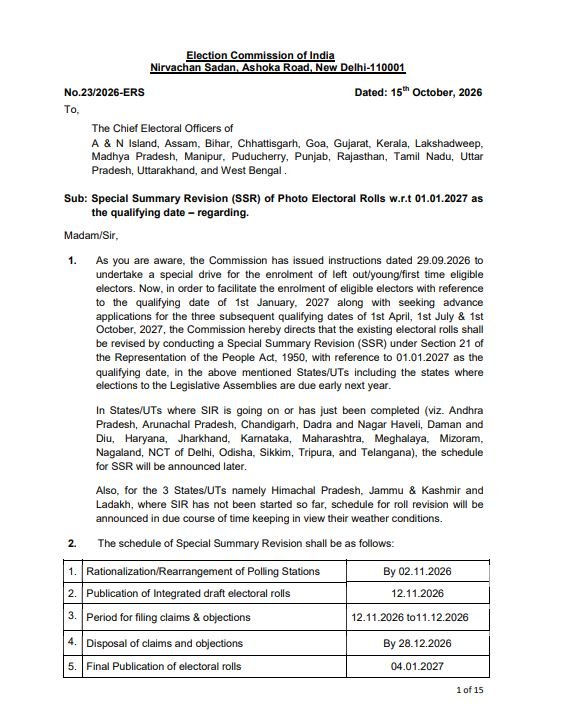
In a letter dated October 15, 2026, bearing reference number 23/2026-ERS, the Commission directed that existing electoral rolls be revised under Section 21 of the Representation of the People Act, 1950, with January 1, 2027, as the qualifying date.
The exercise aims to facilitate the enrolment of eligible citizens, particularly those whose names have not yet been included in electoral rolls, young voters and first-time electors. It will also provide an opportunity to correct existing entries, update photographs and improve the organisation of polling stations.
The Commission has also provided for advance applications from citizens who will become eligible on April 1, July 1 and October 1, 2027.
According to the schedule, polling station rationalisation and rearrangement must be completed by November 2, 2026. The integrated draft electoral rolls will be published on November 12, while the final rolls are scheduled for publication on January 4, 2027.
Assam Among 17 States and Union Territories
The Election Commission has sent its directive to the Chief Electoral Officers of 17 states and Union Territories.
The list includes:
- Andaman and Nicobar Islands
- Assam
- Bihar
- Chhattisgarh
- Goa
- Gujarat
- Kerala
- Lakshadweep
- Madhya Pradesh
- Manipur
- Puducherry
- Punjab
- Rajasthan
- Tamil Nadu
- Uttar Pradesh
- Uttarakhand
- West Bengal
The exercise is particularly relevant to states where Assembly elections are due early next year, including Uttar Pradesh, Uttarakhand, Punjab, Manipur and Goa.
For Assam, the revision will provide an opportunity for eligible citizens who are not registered as voters to apply for inclusion and for existing electors to check and correct their details.
The directive specifically includes Assam in the present SSR schedule. States and Union Territories where the Special Intensive Revision (SIR) is ongoing or has recently been completed will receive their SSR schedules later.
September 29 Special Drive to Enrol Left-Out and First-Time Voters
The October 15 directive follows instructions issued by the Election Commission on September 29, 2026, for a special drive to enrol eligible citizens whose names had been left out, along with young and first-time voters.
The latest instructions provide for the revision of existing electoral rolls with reference to January 1, 2027, as the qualifying date.
The Commission has also asked electoral authorities to make maximum efforts to receive applications from three categories of prospective electors:
- Eligible citizens who had not enrolled by October 1, 2026, or earlier.
- Prospective electors who will be eligible by January 1, 2027.
- Prospective electors who will become eligible on April 1, July 1 or October 1, 2027.
However, the Commission has clarified that applications linked to the three subsequent qualifying dates will be disposed of in the respective quarters under its existing guidelines. During the current round, claims and objections relating to the January 1, 2027, qualifying date will be considered for disposal under the prescribed procedure.
Special Summary Revision 2027: Complete Schedule
The Election Commission has specified the following schedule for the Special Summary Revision of electoral rolls.
| Activity | Deadline |
|---|---|
| Rationalisation and rearrangement of polling stations | By November 2, 2026 |
| Publication of integrated draft electoral rolls | November 12, 2026 |
| Filing of claims and objections | November 12–December 11, 2026 |
| Disposal of claims and objections | By December 28, 2026 |
| Final publication of electoral rolls | January 4, 2027 |
The publication of the draft rolls will allow citizens to check whether their names and other details have been correctly recorded.
Eligible citizens who find that their names are missing or their details are incorrect can submit the appropriate applications or objections during the notified period.
The Chief Electoral Officer of Assam and the concerned Electoral Registration Officers will provide the relevant state-level information and implementation instructions.
Four Qualifying Dates for Voter Registration in 2027
The principal qualifying date for the current revision is January 1, 2027. The Election Commission has also allowed advance applications for three subsequent qualifying dates.
These dates are:
- January 1, 2027
- April 1, 2027
- July 1, 2027
- October 1, 2027
The arrangement is intended to facilitate enrolment for eligible citizens who meet the applicable requirements on different dates during the year.
Applicants should note that submitting an advance application does not mean that every application will be disposed of during the current revision. The Commission has specified that applications linked to the three subsequent qualifying dates will be processed in the respective quarters according to its guidelines.
What Is the Difference Between SSR and SIR?
The Special Summary Revision (SSR) is a process for updating existing electoral rolls, including the addition of eligible electors, correction of entries and consideration of claims and objections under the prescribed rules.
The Special Intensive Revision (SIR) is a separate electoral-roll revision exercise involving more intensive verification.
The Election Commission has stated that the SSR schedule will be announced later for states and Union Territories where SIR is ongoing or has recently been completed.
These include Andhra Pradesh, Arunachal Pradesh, Chandigarh, Dadra and Nagar Haveli, Daman and Diu, Haryana, Jharkhand, Karnataka, Maharashtra, Meghalaya, Mizoram, Nagaland, the National Capital Territory of Delhi, Odisha, Sikkim, Tripura and Telangana.
For Himachal Pradesh, Jammu and Kashmir, and Ladakh, the schedule for electoral-roll revision will be announced in due course, taking weather conditions into account, as SIR has not yet started in these three states and Union Territories.
Assam is among the 17 states and Union Territories covered by the present SSR directive.
Polling Stations to Be Reviewed; 1,200-Elector Limit Specified
The Election Commission has directed electoral authorities to rationalise polling stations after conducting physical verification of polling station locations and the relevant parts of electoral rolls.
Electoral Registration Officers (EROs) must assess whether new polling stations are required, taking into account the Commission’s instruction that no polling station should have more than 1,200 electors without prior approval from the Commission.
Where new polling stations are proposed, electors should be distributed as equitably as possible among polling stations at the same location.
The directive also requires polling station boundaries to be clearly defined so that there are no overlaps with other polling station areas.
Electors should not ordinarily be required to travel more than two kilometres to reach their polling stations or cross natural barriers. Polling stations should be located on the ground floor or at road-entry level.
The Commission has further instructed officials to conduct surveys in high-rise residential complexes, group housing societies, residential welfare association colonies and urban slum clusters to assess the need for additional polling stations.
District Election Officers must physically verify existing and proposed polling station buildings, consult representatives of recognised political parties before finalising proposals for new polling stations and send consolidated proposals through the Chief Electoral Officer for the Commission’s approval.
The rationalisation exercise is intended to improve accessibility, remove ambiguity in polling station boundaries and make voting facilities more convenient for electors.
Voter Addresses and Family Grouping to Be Standardised
The directive includes detailed instructions for standardising addresses in electoral rolls.
Electoral authorities must maintain mandatory address details, including the ward, street or road, locality, village or town, district, state and PIN code, as applicable. Other fields, such as house number, floor, building, apartment and landmark, may also be included where necessary.
Where an official house number is unavailable, a notional number may be assigned and identified as such.
The Commission has also directed EROs to keep family members residing at the same address together in the same section and polling station, as far as feasible. Electors living in the same building, street or residential colony should also be grouped together wherever possible.
These measures are intended to improve the organisation and accuracy of electoral records and reduce confusion over polling station assignments.
Aadhaar Number Is Voluntary for Voter Registration
The Election Commission has clarified that applicants may voluntarily provide their Aadhaar numbers in Forms 6 and 8.
Providing an Aadhaar number is not mandatory for inclusion in the electoral rolls. An application for inclusion cannot be rejected solely because an applicant is unable to furnish an Aadhaar number. Similarly, an entry cannot be deleted from the electoral roll on that ground alone.
The Commission has encouraged electors to submit applications online through the Voter Service Portal at voters.eci.gov.in or through the ECINET application.
Eligible citizens should use the prescribed forms and provide the required information and supporting documents for the electoral service they are seeking.
Which Forms Are Required for Voter Registration?
The Election Commission has specified the following forms for different electoral services.
Form 6: Inclusion of a name
Eligible applicants seeking inclusion in the electoral roll must submit Form 6.
Form 6A: Overseas Indian electors
Eligible overseas Indian electors must use Form 6A for enrolment, subject to the applicable requirements.
Form 7: Objections and deletion of names
Form 7 is used for objections to the proposed inclusion of a name or applications for deletion of an existing entry. The directive specifies that an objection to a proposed inclusion must be submitted by a person whose name is already on the electoral roll of the same Assembly constituency.
Form 8: Corrections and other changes
Form 8 is used for shifting residence within or outside a constituency, correction or updating of entries, replacement of an Elector Photo Identity Card (EPIC) and marking persons with disabilities in the electoral database.
Applicants should select the appropriate form and follow the prescribed procedure.
Safeguards Against Wrongful Deletion of Voter Names
The Election Commission has included specific safeguards to prevent wrongful deletion of names from electoral rolls.
Where individual citizens, Booth Level Agents of political parties or representatives of residential welfare associations report repeated or multiple entries, Booth Level Officers (BLOs) must conduct field verification in each case.
Confirmed cases involving duplicate entries, deceased electors and electors who have permanently shifted may be removed only through the prescribed procedure. Form 7 is required in the cases specified by the Commission, subject to the applicable provisions for dealing with the names of deceased electors.
The directive also requires Electoral Registration Officers to personally cross-check deletion cases in two situations:
- When the number of proposed deletions exceeds 2% of the total electors in a polling station’s electoral roll.
- When the same person has filed objections in more than five cases.
The Commission has separately imposed limits on Form 7 applications by individual electors through instructions dated October 9, 2026, to discourage bulk filing of deletion requests.
These safeguards are intended to ensure that objections are examined properly and that eligible citizens are not removed from electoral rolls without due procedure.
BLOs to Verify Photographs and Correct Electoral Records
The Commission has directed all Booth Level Officers to check whether photographs in the electoral database are correct.
Blurred, non-standard, poor-quality or incorrect photographs must be identified and replaced with standard photographs. The directive requires the necessary Form 8 applications and field verification reports to be obtained for image replacement.
EROs, Assistant Electoral Registration Officers (AEROs) and BLO supervisors will monitor compliance.
Electoral authorities must also ensure that claims and objections received during continuous updating are disposed of before publication of the draft electoral rolls, in accordance with the prescribed procedure.
The directive calls for statistical analysis of existing electoral data to identify gaps in enrolment, gender ratios, age groups and other indicators. Particular attention is to be given to the 18–19 age group and to unusual increases or decreases in the number of electors in specific areas.
Officials are expected to compare previous years’ data and examine variations at polling station, constituency, district and state levels.
Special Focus on Women, Tribal Communities and Vulnerable Electors
The Election Commission has directed authorities to take targeted measures to improve enrolment among underrepresented and vulnerable groups, based on statistical analysis.
These groups include:
- Women and transgender persons.
- Scheduled Tribes, including Particularly Vulnerable Tribal Groups (PVTGs).
- Senior citizens.
- Persons with disabilities.
- Sick and economically disadvantaged citizens.
- Other hard-to-reach electors.
The Commission has instructed election authorities to ensure that such citizens are treated with sensitivity and empathy and are not subjected to unnecessary inconvenience or hardship.
Authorities must provide the administrative assistance and facilitation required during the revision process.
The directive also requires state election authorities to coordinate with the relevant departments to identify and assist persons with disabilities who need appropriate facilities at polling stations.
Information about disability may be provided through the prescribed forms and used to flag eligible electors in the electoral database for assistance. The Commission has expressly stated that disability information must not be reflected in the electoral roll itself.
Help Desks and Special Camps for Vulnerable Citizens
The Commission has directed Chief Electoral Officers to ensure that sufficient help desks are established at district or Assembly constituency level to facilitate voter enrolment.
Particular attention is to be given to migrants, vulnerable citizens and marginalised groups. Contact details of help desks should receive wide publicity.
Special drives and camps may also be organised for people living in night shelters, labour colonies and other difficult circumstances, including homeless and marginalised citizens.
The Commission has allowed state election authorities to determine additional special campaign dates during the claims and objections period according to local requirements.
These provisions are intended to improve access to voter registration for citizens who may face practical difficulties in completing the process.
Booth Level Agents of Political Parties Can Submit Forms
The directive provides for the participation of Booth Level Agents (BLAs) appointed by recognised political parties during the revision process.
Political parties are encouraged to appoint a BLA for every polling station, where one has not already been appointed. BLAs will work with BLOs during the revision period.
A BLA may collect completed Forms 6, 7 and 8 from electors and submit up to 10 forms to the BLO per day. The BLO must nevertheless verify the facts in each application by visiting the claimant’s or objector’s address, as required under the applicable guidelines.
If a BLA submits more than 30 applications during the entire claims and objections period, the ERO or AERO must conduct cross-verification personally.
The BLA must also submit a list of applications with a declaration that the particulars have been personally verified and are believed to be correct.
These provisions are intended to involve recognised political parties in the revision process while retaining verification responsibilities with election officials.
Claims and Objections Must Follow the Prescribed Procedure
The Election Commission has directed EROs to publish lists of claims and objections in the prescribed formats and display them on official notice boards.
The lists must also be made available on the website of the Chief Electoral Officer so that citizens can examine them and raise objections where necessary.
EROs are required to share printed lists of claims and objections with recognised political parties on a weekly basis and maintain records of meetings and acknowledgements.
The Commission has also specified procedural safeguards before an objection or claim is decided. These include the required notice period, publication of the relevant lists and an opportunity for the affected person to respond in cases where a name is proposed for deletion.
Where an objection requires a hearing, the ERO must follow the applicable rules and give the person concerned an opportunity to be heard before passing an order.
The Commission has directed officials to ensure that applications are properly completed, signed where required and processed under the Registration of Electors Rules, 1960.
What Happens If a Voter’s Application Is Rejected?
The Election Commission’s directive also refers to the right of appeal against decisions of Electoral Registration Officers.
Under Section 24 of the Representation of the People Act, 1950, an appeal against an ERO’s decision lies first to the District Magistrate under Section 24(a). A second appeal against the decision of the first appellate authority lies to the Chief Electoral Officer under Section 24(b), in accordance with the prescribed procedure.
Eligible citizens whose applications or objections are decided against them should consult the applicable rules and official instructions to determine the relevant appeal procedure and deadlines.
The availability of an appeal provides a formal mechanism for challenging decisions concerning electoral registration.
Chief Secretaries Asked to Provide Staff and Resources
The Election Commission has directed state and Union Territory administrations to ensure that officials involved in the revision receive adequate manpower and resources.
The Chief Secretaries must ensure that Chief Electoral Officers, District Election Officers, Electoral Registration Officers, Assistant Electoral Registration Officers, BLO supervisors, BLOs and other officials have the necessary administrative support.
Notified posts of District Election Officers, Electoral Registration Officers and Assistant Electoral Registration Officers should not remain vacant during the SSR period.
Officials connected with the exercise cannot be transferred between publication of the draft rolls and publication of the final rolls without the Commission’s prior approval.
If a transfer becomes necessary, a proposal with full justification must be forwarded to the Election Commission through the Chief Electoral Officer.
The directive also states that officials involved in preparing, revising and correcting electoral rolls will be deemed to be on deputation to the Election Commission for the period of their deployment and will remain subject to its control, superintendence and discipline.
What Voters in Assam Should Do
Eligible citizens in Assam should monitor announcements issued by the Chief Electoral Officer of Assam and their respective Electoral Registration Officers.
Those who are eligible but have not enrolled should apply using the appropriate form. Existing voters should check their details when the integrated draft electoral rolls are published on November 12, 2026.
If a name is missing or an entry is incorrect, the voter should submit the appropriate claim or application within the notified period, which runs until December 11, 2026.
Applications for inclusion, correction, shifting of residence and replacement of EPIC should be submitted using the relevant forms. Citizens should retain the acknowledgement or reference number for applications submitted through official channels.
Voters should also remember that providing an Aadhaar number is voluntary for the services specified in the directive.
For assistance, citizens should consult the official Election Commission portal, the ECINET application, the Chief Electoral Officer of Assam or the relevant electoral registration office.
Final Voter List Scheduled for January 4, 2027
The Special Summary Revision will cover enrolment, corrections, polling station rationalisation and the processing of claims and objections in the 17 states and Union Territories included in the October 15 directive.
The draft electoral rolls are scheduled for November 12, 2026, followed by the claims and objections period ending on December 11. Claims and objections are to be disposed of by December 28, and the final electoral rolls are scheduled for publication on January 4, 2027.
For eligible citizens in Assam, the revision provides an opportunity to ensure that their names and details are correctly recorded before the final rolls are published.