


New Delhi, October 25, 2026: The Association for Democratic Reforms (ADR) and National Election Watch (NEW) have identified 187 sitting MPs and MLAs with cases related to crimes against women, based on disclosures in their election affidavits. The report highlights questions about candidate selection and political accountability. These are declared cases and do not establish that the lawmakers concerned have been convicted.
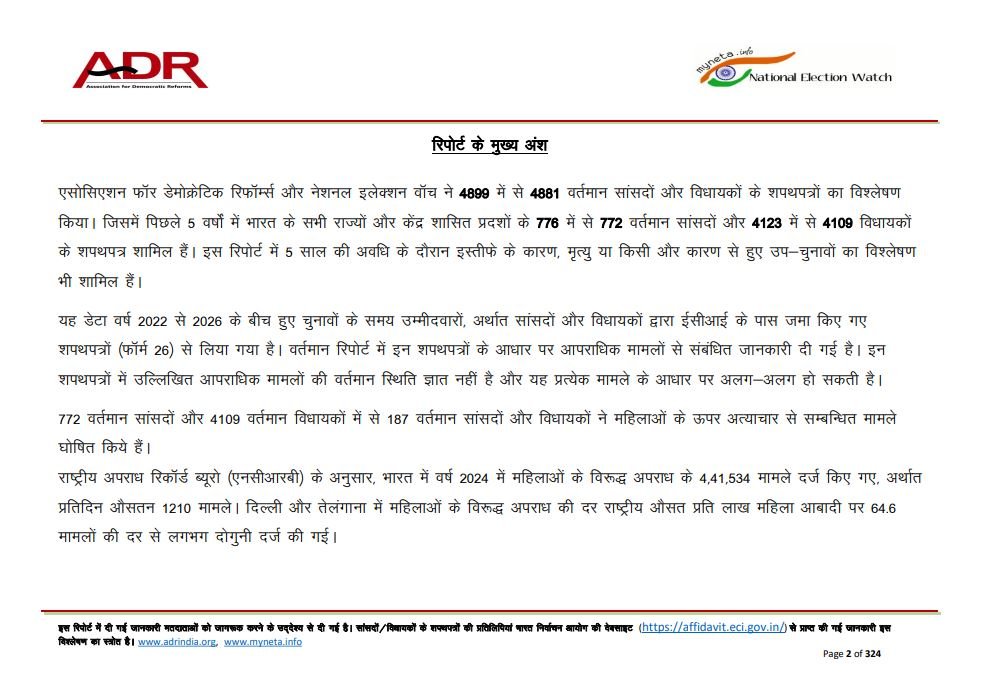
The report, published on October 23, 2026, found that 19 sitting MPs and 168 sitting MLAs had declared such cases. The analysis examined 4,881 election affidavits out of 4,899 available affidavits of sitting MPs and MLAs from across the country.
The findings have brought renewed attention to the criminal cases disclosed by elected representatives, the selection of candidates by political parties and the need for greater accountability in India’s electoral process.
The report does not establish that the lawmakers concerned have been convicted. It is based on criminal cases declared in their election affidavits, and the current status of these cases may vary.
Nearly 4,900 Election Affidavits Analysed
ADR and National Election Watch examined 772 out of 776 affidavits of sitting MPs and 4,109 out of 4,123 affidavits of sitting MLAs.
The data was collected from Form 26 election affidavits submitted to the Election Commission of India by candidates who contested elections between 2022 and 2026. The analysis also included affidavits filed during by-elections held during this period.
Of the 4,881 elected representatives whose affidavits were analysed, 187 had declared cases related to crimes against women. This represents approximately 3.8% of the representatives covered by the analysis.
The report examines disclosures made by elected representatives and should not be interpreted as a record of convictions.
BJP Leads Party-Wise List, Followed by Congress and TDP
The party-wise analysis found that the Bharatiya Janata Party (BJP) had the highest number of sitting MPs and MLAs who declared cases related to crimes against women.
According to ADR, the party-wise figures are:
- BJP: 106 MPs and MLAs
- Indian National Congress (INC): 20 MPs and MLAs
- Telugu Desam Party (TDP): 18 MPs and MLAs
These figures represent the number of lawmakers with declared cases identified in the analysis. They do not establish guilt or show the proportion of each party’s total elected strength unless compared with the total number of representatives belonging to that party.
The findings raise questions about how political parties assess candidates’ backgrounds before granting them election tickets and what steps they take when candidates disclose serious criminal cases.
West Bengal Tops State-Wise List
West Bengal recorded the highest number of sitting MPs and MLAs who declared cases related to crimes against women, with 69 representatives.
Andhra Pradesh ranked second with 22, followed by Odisha with 17.
The state-wise figures are:
- West Bengal: 69
- Andhra Pradesh: 22
- Odisha: 17
These are absolute numbers, not rates adjusted for the total number of elected representatives in each state. Therefore, the figures should not automatically be interpreted as indicating which state has the highest proportion of lawmakers with such disclosures.
The findings nevertheless highlight the importance of transparency in candidate selection and the need for voters to have access to accurate information about candidates’ declared criminal backgrounds.
14 Lawmakers Declare Rape-Related Cases
One of the most serious findings concerns rape-related cases.
According to the ADR analysis, 14 of the 187 sitting MPs and MLAs who declared cases related to crimes against women also declared cases related to rape under Sections 376 and 376(2)(n) of the Indian Penal Code (IPC).
Of these 14 representatives, two are sitting Lok Sabha MPs and 12 are sitting MLAs.
The party-wise breakdown identifies four BJP representatives and four Congress representatives among those who declared rape-related cases.
The BJP figure comprises two MPs and two MLAs, while all four Congress representatives are MLAs.
The report also identifies one sitting MLA each from the following parties:
- Telugu Desam Party (TDP)
- Democratic Trinamool Congress
- Biju Janata Dal (BJD)
- National People’s Party (NPP)
- Bharat Adivasi Party
- All India Secular Front
These disclosures concern cases recorded in election affidavits. They must not be presented as proof that the individuals concerned committed the offences. The legal status and outcome of each case require separate verification.
NCRB Recorded More Than 4.41 Lakh Crimes Against Women in 2024
The ADR findings come against the backdrop of the wider challenge of crimes against women in India.
According to the National Crime Records Bureau (NCRB) figures cited in the report, India registered 4,41,534 cases of crimes against women in 2024.
This works out to approximately 1,210 registered cases a day. The national crime rate was 64.6 cases per lakh women, while Delhi and Telangana recorded rates of around twice the national average, according to the report.
These figures refer to cases registered by the police. They do not necessarily represent the total number of offences committed, as not every incident is reported or registered.
The NCRB figures and the ADR analysis measure different things. NCRB records police-registered cases of crimes against women, whereas ADR examines criminal cases declared by elected representatives in their election affidavits. The two sets of figures should not be treated as directly equivalent.
Candidate Selection and Political Accountability Under Scrutiny
The findings have renewed questions about the responsibility of political parties to scrutinise candidates before elections.
Voters rely on election affidavits to understand a candidate’s declared criminal background and other relevant information. Transparent disclosure and careful examination of these records are important for informed electoral choices.
The report also raises questions about whether political parties consistently apply their own standards when selecting candidates who have declared serious criminal cases.
At the same time, the distinction between an allegation, a pending criminal case and a conviction remains essential. Every case must be assessed on its own facts and legal status, and the accused retain the right to a fair judicial process.
What Does ADR Recommend?
ADR has recommended stronger measures to address the issue of candidates with criminal backgrounds in electoral politics.
Among its recommendations are:
- Candidates with criminal backgrounds should be barred from contesting elections.
- Candidates convicted of heinous crimes, such as rape, should be permanently disqualified from contesting elections.
- People with serious criminal backgrounds, particularly cases involving crimes against women, should not be appointed as ministers.
- Political parties that fail to comply with Supreme Court directions on publishing candidates’ criminal antecedents and explaining their selection should face substantial financial penalties, with accountability for the officials responsible for compliance.
These are recommendations made by ADR and should not be confused with a statement of the law currently in force. Any proposed disqualification or other legal restriction would have to operate within the applicable constitutional and statutory framework.
Conclusion
The ADR and National Election Watch analysis places the declared criminal backgrounds of elected representatives under renewed public scrutiny. With 187 sitting MPs and MLAs reporting cases related to crimes against women, the findings underline the importance of transparent candidate selection, informed voting and accountability in public life.
The central issue is not merely the number of cases disclosed, but also whether political parties conduct meaningful scrutiny, voters receive reliable information and criminal cases are handled through a fair and timely judicial process.